
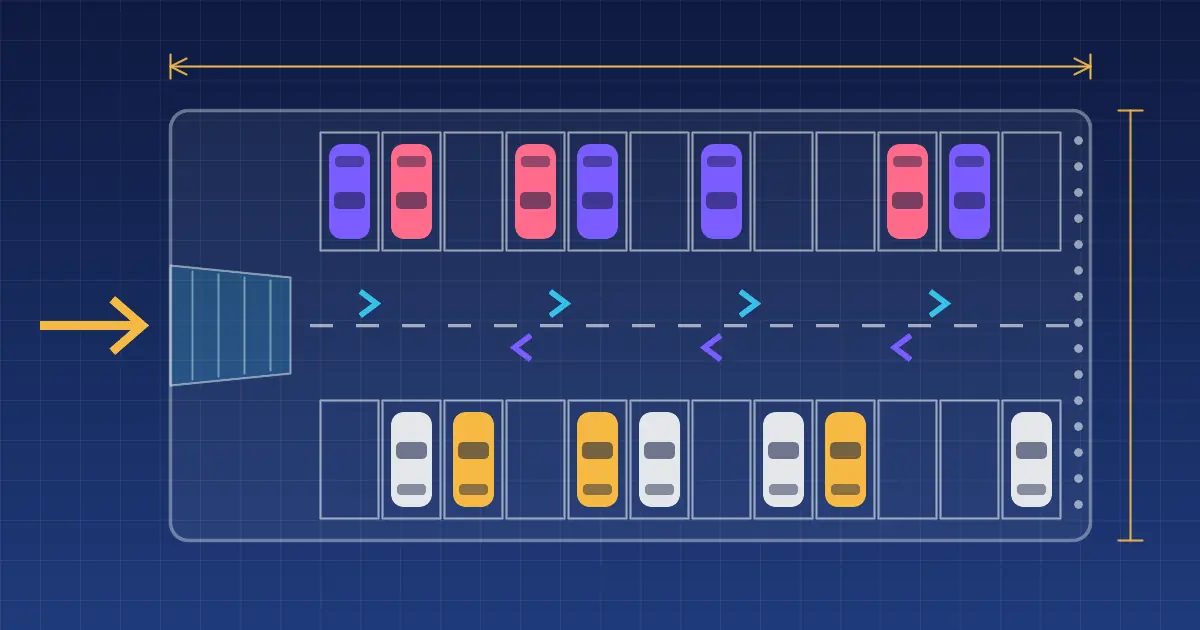
What should you check before planning a parking lot? Questions first, drawings later: who will park there, when, how many vehicles will arrive at peak hour and how they will enter and exit. Only once the answers are clear should you decide on the number of spaces, the layout and the operating method, so that parking lot planning rests on data rather than estimates.
This guide is intended for developers and property managers facing a new project or the renovation of an existing parking lot. It explains what is worth checking before approaching planners, and how to avoid decisions that are hard to change later.
What to check before planning a parking lot: purpose and users
The first step is to define who the parking lot serves. A parking lot for residents is different from one for offices, a shopping center or public parking. That difference shapes every decision that follows. So it is worth answering a few basic questions:
- Who the users are: residents, employees, visitors, subscribers or occasional parkers.
- On which hours and days there is heavy demand, and what happens during seasons or special events.
- Whether a change in the use of the property is expected in the coming years, such as additional construction or new operating hours.
- Whether the parking lot is also meant to generate income, or only to serve the property.
Site and surrounding data
The condition of the land and the building limits the options. That is why checking before planning a parking lot also includes basic data about the site:
- Area, plot shape and available clearance heights.
- Possible locations of entrances and exits in relation to the street and its traffic load.
- Proximity to intersections, public transport stops and pedestrian crossings.
- Existing building systems, such as electricity, communications and drainage.
- Adjacent buildings and the effect of the parking lot on them, for example noise or traffic.
Traffic, safety and accessibility
One of the risks in parking lot planning is focusing on the number of spaces and neglecting traffic flow. A parking lot with many spaces but a narrow entrance may create a queue that blocks the street. What to check:
- How many vehicles enter and exit at peak hour, and whether there is waiting space inside the property rather than on the street.
- Separation between vehicle routes and pedestrians, including marked pedestrian crossings and sufficient lighting.
- Clear signage at the entrance, on each level and at the exit.
- Accessible parking spaces and accessible walking routes. Parking accessibility is governed by provisions in the Israeli planning and building regulations and the equal rights for persons with disabilities regulations, so check with an accessibility consultant what applies to your project.
- Lighting, ventilation and drainage, and in a covered parking lot also fire safety and evacuation aspects, which should be checked with a safety consultant.
The exact requirements depend on the type of parking lot and its location. So verify them with the planner, the safety consultant and the local authority, rather than relying on a general estimate.
Control, payment and operation already at the planning stage
The operating method determines the physical design, so it is worth thinking about it early. A barrier, license plate recognition or an entry card require power and communications infrastructure, as well as space for kiosks and waiting. Points to check:
- How people enter and exit: barrier, card, subscription or license plate recognition.
- How people pay, and what happens in case of a malfunction or a communications outage.
- Who operates the parking lot and who manages it, on site and remotely.
- Whether to prepare infrastructure for electric vehicle charging now. The field keeps changing, so check with the planner and the local authority whether relevant requirements apply.
Permits, licensing and timelines
The required permits and licenses depend on the type and size of the project, the local authority and current law. For example, some parking lots require a business license, and construction or alteration usually requires a building permit. So it is worth clarifying them at the start, not just before opening. A delay in a permit may postpone the entire project.
It is also worth building a realistic schedule that includes specification, planning, approvals, construction and a trial run.
Checklist: what to check before planning a parking lot
- Define the users, the peak hours and the expected scope of use.
- Collect the site data: dimensions, heights, entrances and infrastructure.
- Check traffic at the entrance and exit, including waiting space.
- Define accessibility, safety and lighting together with the authorized parties.
- Choose a control and payment method, and prepare infrastructure for it.
- Find out which permits and licenses are needed, and set a schedule.
Questions and answers about parking lot planning
When should parking lot planning begin?
Already at the stage of examining the feasibility of the property, before finalizing the architectural design and the construction budget. Changes at a late stage cost money and time.
Can a parking lot be planned without traffic data?
You can start with an initial estimate based on similar use, but it is worth validating it with counts or data from a similar parking lot. Better data leads to planning that is closer to actual use.
Who takes part in parking lot planning?
Usually the developer or property owner, an architect, a traffic engineer, a safety and accessibility consultant and whoever will operate the parking lot. When the operator takes part already at the planning stage, fewer corrections are needed later.
The information in this guide is general. It does not constitute engineering approval, legal advice or fire safety approval, and requirements vary according to the local authority and the project.
How to proceed
Yam Parking provides consulting and planning services in the parking field, for on street parking and for parking lots (off street). To get started, you can prepare the site details, the project goals, existing information about the parking situation and the desired timelines in advance.